

At 8:12 on a snowy Tuesday, a Boise medical office realized its scheduling system was down. By 9:00, the front desk was handwriting appointments, phones were stacking up, and the waiting room was filling with frustrated patients. That is what managed IT services in Boise are really about: preventing small warning signs from turning into expensive business interruptions.
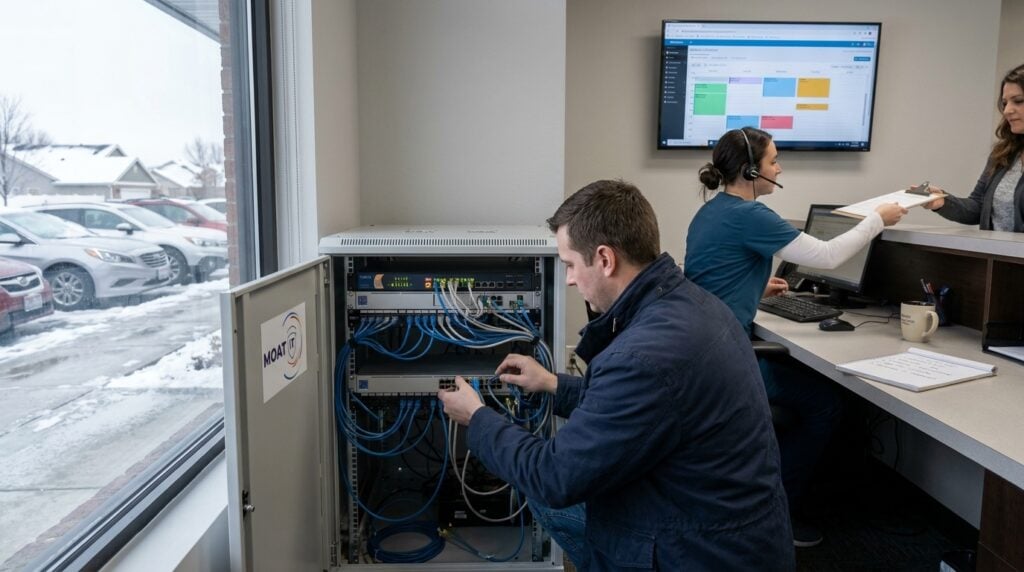
Table of Contents
- Managed IT Services in Boise That Keep Idaho Businesses Running
- What Managed IT Services in Boise Actually Include
- Help Desk Support That Protects Productivity
- Cybersecurity Is Now Basic IT Hygiene
- Cloud, Backup, and Disaster Recovery
- Why Reactive IT Support Ends Up Costing More
- Why Boise Businesses Choose a Managed IT Services Partner
- Managed IT Support for Idaho Industries
- Why Choose MOATiT for Managed IT Services in Boise
- Frequently Asked Questions About Managed IT Services Boise
Managed IT Services Boise, ID | Proactive IT Support for Idaho Businesses
Last winter, a small medical office near Meridian lost access to its scheduling system for half a day after a server issue that had been “acting weird” for weeks. Nobody expected it to become a serious outage. Then the phones backed up, staff started writing patient notes on paper, and the owner had to explain delays to a room full of patients.
By the end of the day, the practice had lost appointments, paid overtime, and burned trust it had spent years building.
We see versions of that story across the Treasure Valley. A Boise law firm keeps fighting the same email outage. A Nampa manufacturer replaces workstations only after they fail. A dental group in Eagle gets a phishing scare and realizes nobody has really owned security. Businesses searching for managed IT services Boise are usually not looking for theory. They want fewer disruptions, faster support, and a partner who keeps the business running.
Managed IT Services in Boise That Keep Idaho Businesses Running
If your team depends on Microsoft 365, cloud files, line-of-business software, VoIP, payment systems, or remote access, IT already affects revenue. Yet many Idaho businesses still treat support like emergency plumbing. They call when something breaks, pay to patch it, and hope it holds.
That approach feels cheaper right up until it is not.
In an eight-person office, losing just 45 minutes per employee each week to login problems, printer failures, unstable Wi-Fi, or slow machines adds up to six hours of lost work. At a loaded labor cost of $35 per hour, that is about $840 per month, or more than $10,000 per year, before you count missed client calls or delayed projects. Those numbers are illustrative and should be adjusted to your payroll reality, but the pattern is real.
The bigger cost is interruption at the wrong moment. A healthcare practice cannot afford downtime during patient intake. An accounting firm cannot lose file access during a deadline week. A hospitality group cannot have its POS system fail on a busy weekend. In each case, the invoice for the IT issue is often smaller than the cost of the disruption it caused.
That is why a good Boise IT partner does more than close tickets. They learn how your business actually works, where failure hurts most, and which systems need attention before they break.
What Managed IT Services in Boise Actually Include
Managed IT services are ongoing outsourced support, monitoring, maintenance, cybersecurity, and planning delivered for a predictable monthly fee. The goal is not simply to fix problems faster. The goal is to prevent more of them, reduce risk, and give your business a stable technology foundation.
That definition is useful, but the practical version matters more. Well-managed services should make your day quieter. Your employees stop chasing basic tech issues. Leadership gets clearer visibility into risk, replacement cycles, and system health. Support becomes a process instead of a scramble.
Proactive Monitoring and Maintenance
Most outages give warnings first. Hard drives throw errors. Storage fills up. Backups start failing. Firewall logs show repeated issues. Patches sit uninstalled for too long.
Proactive monitoring catches those signs early, when the fix is still manageable. In practice, that means watching device health, failed backups, patch status, endpoint alerts, and network performance before users start reporting that “everything feels slow.”
This is one of the clearest differences between reactive support and managed service. Reactive support waits for a person to notice the problem. Proactive support looks for the signal before the problem reaches payroll, patient care, or customer service.
Help Desk Support That Protects Productivity
Most IT issues are not dramatic. They are repetitive, annoying, and expensive because they steal time in small pieces. A user cannot sign in. Outlook will not sync. A printer disappears. A shared folder will not open. Individually, those are small. Across a month, they erode productivity.
A structured help desk matters because speed alone is not enough. Good support also depends on documentation, standardization, and ownership. When a provider already knows your users, devices, vendors, and environment, they spend less time discovering the issue and more time resolving it.
For Boise-area businesses, local support can matter here. If the ISP is involved, if a firewall needs hands-on work, or if an office move is underway, having a team that understands the region and can support onsite work changes the experience.
Cybersecurity Is Now Basic IT Hygiene
Most small and midsize businesses do not think they are likely targets until they deal with phishing, account compromise, or ransomware exposure. The problem is that many attacks do not start with sophisticated techniques. They start with weak passwords, missing patches, stale accounts, or a user clicking the wrong email.
A modern managed IT program should include endpoint protection, patch management, MFA support, access controls, email security, backup oversight, and user guidance. For regulated businesses, it should also support documentation, policy alignment, and audit readiness.
The discipline matters more than the tools alone. We have seen environments with decent software still carry major risk because nobody was reviewing alerts, disabling old accounts, testing restores, or enforcing standards consistently.
According to IBM’s Cost of a Data Breach Report, the financial impact of a breach remains significant year after year, and smaller organizations often feel that impact more sharply because they have less internal depth and fewer recovery resources. [citation needed for exact year/version referenced]
Microsoft has also repeatedly warned that identity-based attacks, phishing, and unpatched systems remain common entry points for compromise. [citation needed for exact report referenced]
Cloud, Backup, and Disaster Recovery
Cloud tools made work more flexible. They also made many environments messier.
Now your files, identities, devices, and apps live in multiple places. Microsoft 365 may handle email and collaboration, but that does not automatically mean your backup strategy is complete, your permissions are clean, or your offboarding process is secure.
This is where many businesses get a false sense of safety. They assume data is protected because it lives in the cloud. Sometimes it is. Sometimes it is not protected the way they think.
A usable managed service plan should cover Microsoft 365 administration, license management, user permissions, backup validation, and disaster recovery planning. The key word is validation. A backup that has never been tested is a theory, not a recovery plan.
Network, Server, and Endpoint Management
Most businesses do not need flashy infrastructure. They need reliable infrastructure.
That means stable Wi-Fi, secure firewall rules, healthy workstations, updated servers, managed endpoints, and a replacement plan for aging hardware. If your office opens every morning and technology quietly works, that is not luck. It usually means someone is maintaining standards behind the scenes.
The companies that struggle most are often not underinvesting everywhere. They are underinvesting inconsistently. One office has decent laptops. Another has five-year-old machines. One backup process exists on paper. Another has never been checked. Those gaps are where downtime tends to start.

Why Reactive IT Support Ends Up Costing More
Break-fix support looks simple because the invoice appears only when something fails. What it hides is delay.
The owner stops what they are doing to call a vendor. Staff wait around for access. The same issue returns two weeks later because the root cause was never addressed. Meanwhile, projects keep moving, so preventive work gets pushed off again.
That cycle is familiar. Most businesses do not move to managed services after one dramatic outage. They move after the fifth recurring problem. The backup has not been tested. Remote access is unreliable. New hires are onboarded differently every time. Security settings drift. Nobody is fully sure who owns what.
That slow operational drag is often the real reason companies switch.
Why Boise Businesses Choose a Managed IT Services Partner
A lot of Idaho businesses reach the same point. They have outgrown ad hoc support, but they are not ready to hire a full internal IT team with help desk, security, infrastructure, and strategic planning covered under one salary budget.
Managed services fill that middle ground.
The value is not just outsourcing. It is getting structure. Costs become more predictable. Issues get handled faster because systems are documented. Preventive work actually happens because it is part of the service model, not an optional extra that gets delayed for another quarter.
A good partner also helps leadership make better decisions. If a Boise office is opening a second location in Nampa, planning matters. If a Meridian firm wants tighter onboarding and offboarding controls, that needs process. If a growing company is deciding whether to keep an aging server or move workloads to the cloud, that takes guidance, not guesswork.
Managed IT Support for Idaho Industries
Different industries break in different ways. A provider who understands that will usually deliver better support than one using the same template for every client.
Managed IT Services Boise for Healthcare and Dental Practices
Healthcare and dental teams depend on uptime at the front desk as much as in the back office. When a workstation is slow, an imaging app fails, or the schedule goes offline, the whole day starts to unravel.
These environments usually need strong endpoint controls, secure email, reliable EHR access, backup validation, MFA, and fast user support. They also need a provider who understands that downtime affects patient experience, not just staff convenience.
Managed IT Services Boise for Legal and Accounting Firms
Legal and accounting teams live in deadline-driven workflows. They handle confidential data, depend on stable document access, and cannot afford remote access failures during busy periods.
This is where disciplined permissions, secure file handling, tested backups, and consistent workstation standards matter. Tax season and litigation deadlines are terrible times to discover your backup coverage is incomplete.
Managed IT Services Boise for Hospitality, Agriculture, and Local Businesses
Hospitality companies need reliable connectivity, phones, payment systems, and guest-facing tools. Agriculture businesses may need support across remote locations, seasonal staffing changes, and mixed office-field environments. Other local businesses across Boise, Meridian, Eagle, and Nampa often share the same core issue: limited internal IT capacity and no tolerance for downtime.
The right service model should reflect that reality instead of forcing every business into the same support package.
Why Choose MOATiT for Managed IT Services in Boise
Boise businesses do not need another vendor who appears after the outage. They need a partner who helps prevent it.
MOATiT provides proactive IT support with a broader view of business operations. Alongside managed IT, the team also works across cybersecurity, hosting, web development, SEO, CRM, and automation. For companies trying to align operations, security, and growth, that cross-functional perspective can reduce handoff problems between vendors.
That does not mean every business needs every service. It means your IT partner should understand how technology decisions ripple into marketing systems, customer experience, security, and internal workflows.
Local Support Across Boise and the Treasure Valley
A provider serving Boise, Meridian, Nampa, Eagle, and nearby markets should understand local connectivity challenges, regional growth patterns, and the realities of supporting businesses that may need both remote and onsite help.
Local presence also improves accountability. When support is nearby, communication is usually clearer and escalation is easier.
Tailored Support Instead of a Generic Package
Some companies need fully managed support. Others need co-managed help for internal staff. Some need better Microsoft 365 administration first. Others need to tighten backup discipline, endpoint management, or security controls before anything else.
MOATiT builds service around those priorities instead of treating every environment the same.
Scalable IT That Keeps Up With Growth
A 10-person office in Eagle does not need the same support model as a multi-location healthcare group in Boise. Support should scale with headcount, locations, compliance demands, and operational complexity.
That matters because growth often exposes IT weaknesses fast. New hires need provisioning. New locations need network planning. More vendors create more access points and more risk. If IT does not scale with the business, the business starts working around IT.
Get Managed IT Services in Boise
If your business is tired of recurring outages, slow support, and technology that always seems one step behind, now is the time to fix the pattern.
Think back to that medical office from the opening. The outage did not start the morning the schedule failed. It started weeks earlier, when the warning signs were ignored.
That is what proactive IT changes.
MOATiT helps Idaho businesses move from reactive support to stable, secure, scalable operations. Request a managed IT assessment to identify where your environment is creating avoidable risk, wasted time, or downtime.
Rated 4.9★ on Google by Idaho Businesses
★★★★★
“Our regional organization has partnered with MOATiT as our contracted IT department and the experience has been outstanding. They are reliable, accessible, and true experts in their field — from day-to-day IT operations to top-notch cybersecurity.”
Layne Bourgeous
Director, Southeast Idaho Council of Governments
★★★★★
“The Pocatello-Chubbuck Chamber has been using MOATiT for almost 3 years as our IT Department. They have been wonderful to work with and I really appreciate their responsiveness to our staff.”
Matt Hunter
President, Pocatello-Chubbuck Chamber of Commerce
Book a free IT assessment for your Boise business
15 minutes, no obligation. We’ll review your current setup and show you where you’re exposed — answered by a local Idaho team within one business hour.
Frequently Asked Questions About Managed IT Services Boise
What are managed IT services?
Managed IT services are ongoing outsourced technology support for a business. They usually include monitoring, maintenance, help desk support, cybersecurity, backups, and planning delivered for a monthly fee.
How much do managed IT services cost in Boise?
Pricing depends on the number of users, devices, locations, compliance requirements, and service scope. Many providers price per user, per device, or through a flat monthly agreement tied to a defined support package.
What businesses should outsource IT support?
Businesses that rely heavily on technology but do not want the cost of building a full in-house IT department are often strong candidates. That includes healthcare, dental, legal, accounting, hospitality, agriculture, and growing professional services firms.
Do managed IT services include cybersecurity and cloud support?
Yes, they should. A modern managed IT plan often includes Microsoft 365 support, endpoint protection, MFA, patch management, backups, user access controls, and disaster recovery planning.
FAQ Schema-Ready Q&A
Q: What are managed IT services in Boise?
A: Managed IT services in Boise are outsourced technology support services that include monitoring, maintenance, help desk, cybersecurity, backup, and planning for Idaho businesses.
Q: How much do managed IT services cost in Boise, Idaho?
A: Managed IT services pricing in Boise varies based on users, devices, locations, compliance needs, and whether support is fully managed or co-managed.
Q: Are managed IT services worth it for small businesses?
A: Yes, managed IT services are often worth it for small businesses because they reduce downtime, improve security, and provide predictable support costs without hiring a full internal IT team.
Q: Do managed IT providers help with cybersecurity?
A: Yes, most modern managed IT providers help with cybersecurity through patching, endpoint protection, MFA, access controls, backups, and user security guidance.
Sources
- IBM, Cost of a Data Breach Report
- Microsoft Security insights and threat reporting
- National Institute of Standards and Technology (NIST) Cybersecurity Framework


