

Cybersecurity is no longer just a concern for large enterprises. In 2026, small and midsize businesses (SMBs) are among the most frequently targeted organizations — precisely because attackers know many lack mature defenses and compliance controls. NIST and PCI DSS Compliance for SMBs in Idaho is necessary.
According to Verizon’s Data Breach Investigations Report, nearly half of cyberattacks now target small businesses, with many incidents involving stolen financial or customer data.
That’s why NIST and PCI DSS compliance for SMBs has become a critical business requirement — not just an IT consideration. Two frameworks, in particular, play a central role in helping SMBs stay secure, trusted, and competitive:
- NIST Cybersecurity Framework (NIST CSF)
- PCI DSS 4.0 (Payment Card Industry Data Security Standard)
According to Verizon’s Data Breach Investigations Report, nearly half of cyberattacks now target small businesses, with many incidents involving stolen financial or customer data.
Let’s break down why both matter — and how aligning with them strengthens your cybersecurity posture in 2026.
What Is NIST Compliance and Why Does It Matter for SMBs?
The NIST Cybersecurity Framework (CSF) provides a structured, risk-based approach to managing cybersecurity threats. While it isn’t legally required for every SMB, it is widely adopted across industries and often expected by enterprise clients, healthcare organizations, and government agencies.
Core NIST cybersecurity principles:
- Identify: Understand your assets, risks, and vulnerabilities
- Protect: Secure systems using access controls, encryption, and backups
- Detect: Continuously monitor for threats and anomalies
- Respond: Maintain an incident response plan
- Recover: Restore operations quickly with tested recovery plans
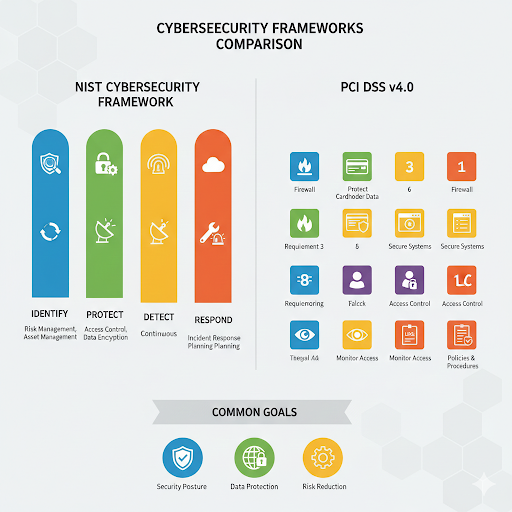
These five functions come directly from the NIST Cybersecurity Framework and give SMBs a simple way to organize security improvements
ALT Text: Comparison of NIST Cybersecurity Framework and PCI DSS 4.0 requirements for small businesses. https://drive.google.com/file/d/1q1kOKiqTr5W9vuCdSVu3_gIEH_vTLql7/view?usp=drive_link
Why NIST matters for SMBs in 2026:
- Builds credibility with larger customers and partners
- Provides a clear roadmap for cybersecurity maturity
- Reduces breach likelihood and long-term recovery costs
NIST is often the foundation upon which other compliance frameworks are built — including PCI DSS.
What Is PCI DSS Compliance and Why Does It Matter?
If your business processes, stores, or transmits credit card data, PCI DSS 4.0 compliance is mandatory — regardless of company size.
PCI DSS focuses specifically on protecting cardholder data and reducing payment fraud.
Key PCI DSS 4.0 requirements for SMBs:
- Secure network architecture (firewalls, segmentation)
- Encryption of cardholder data
- Strong access controls and authentication
- Continuous monitoring and testing
- Documented security policies and employee training
Why PCI DSS compliance is critical:
- Avoid fines and penalties: Non-compliance can result in significant fees from banks and processors
- Reduce breach costs: A single payment data breach can cost SMBs well over six figures
- Maintain customer trust: Compliance signals responsible data handling
These controls align with the core PCI DSS 4.0 requirements defined by the PCI Security Standards Council.
NIST vs. PCI DSS: What SMBs Need to Know
While these frameworks serve different purposes, they work best together.
| Category | NIST CSF | PCI DSS 4.0 |
| Purpose | Voluntary cybersecurity risk framework | Mandatory payment data security standard |
| Scope | Broad — all cybersecurity risks | Narrow — cardholder data only |
| Focus | Identify, Protect, Detect, Respond, Recover | Network security, encryption, access control |
| Industries | All industries | Any business handling card payments |
| Compliance | Recommended, widely adopted | Required by card brands |
| SMB Benefit | Cyber maturity & resilience | Avoid fines & protect financial data |
For many SMBs, NIST CSF offers a broad blueprint for cybersecurity, while PCI DSS 4.0 provides very specific, mandatory requirements for cardholder data environments.
Bottom line:
NIST provides a strong cybersecurity foundation, while PCI DSS ensures payment data protection. Together, they create a complete and defensible compliance strategy for SMBs in 2026.

Practical Steps for SMBs in 2026
To align with NIST and PCI DSS compliance for SMBs, organizations should:
- Start with a Risk Assessment
Identify gaps against both NIST and PCI DSS requirements. - Implement Multi-Factor Authentication (MFA)
Required under PCI DSS 4.0 and strongly recommended by NIST. - Encrypt Sensitive and Cardholder Data
Both frameworks emphasize strong encryption controls. - Train Employees Regularly
Human error remains one of the top causes of breaches. - Work with a Compliance-Focused IT Partner
Many SMBs rely on experienced managed IT services to maintain compliance without internal overhead.
Final Takeaway
For SMBs in Idaho and across the U.S., NIST and PCI DSS compliance in 2026 isn’t about checking boxes — it’s about protecting customer trust, avoiding financial penalties, and building long-term cyber resilience.
At MOATiT, we help SMBs strengthen cybersecurity and compliance through risk assessments, continuous monitoring, and compliance automation. Our team ensures your business is secure, audit-ready, and positioned for growth.
 Schedule a Compliance Readiness Assessment and take control of your cybersecurity posture in 2026.


