
AI phone assistant vs answering service is no longer a simple choice between technology and people. Both options can answer calls when your team is busy, after hours, or helping customers in person. The important difference is what happens after the call is answered.
A traditional answering service usually relies on live agents who follow scripts, collect information, take messages, and route urgent calls. An AI phone assistant uses conversational voice technology to understand requests, answer approved questions, complete routine tasks, and transfer the caller when human judgment is needed.
For many small and midsize businesses, an AI phone assistant is the stronger option when call volume is unpredictable, customers expect immediate help, and the phone needs to connect with scheduling, CRM, ticketing, or other business systems. A live answering service may still be better for emotionally sensitive conversations, unusual situations, or organizations that want a person involved in nearly every call. In many cases, the best design combines both.
Table of Contents
- What is an AI phone assistant?
- What is a traditional answering service?
- Quick comparison
- Nine important differences
- Which option costs less?
- When AI is the better fit
- When a live answering service is the better fit
- Why a hybrid approach may work best
- Questions to ask before choosing
- Frequently asked questions
What Is an AI Phone Assistant?
An AI phone assistant is a voice system designed to hold a natural conversation with a caller. Unlike a basic phone tree that asks callers to press numbers, a modern assistant can interpret spoken requests, ask follow-up questions, use approved business information, and trigger actions in connected software.
Depending on its configuration, it may answer frequently asked questions, schedule or reschedule appointments, qualify leads, create service tickets, send confirmations, collect structured intake information, route urgent calls, or transfer a caller with context. The system should operate within defined rules and clearly hand off situations it is not authorized to handle.
MOATiT’s overview of AI phone assistants for business provides examples across healthcare, home services, legal intake, hospitality, and small teams.
What Is a Traditional Answering Service?
A traditional answering service uses human agents to answer calls on behalf of another business. Agents typically work from account instructions and scripts. They may take messages, ask basic intake questions, route calls, schedule appointments, or notify an on-call employee.
Some answering services dedicate agents to one account, while others use a shared pool that serves many clients. Service quality therefore depends on training, staffing, turnover, script design, access to current information, and how well agents understand the business they represent.
AI Phone Assistant vs Answering Service Quick Comparison
| Category | AI phone assistant | Live answering service |
| Availability | Can operate continuously if configured and supported | Depends on contracted hours and staffing |
| Simultaneous calls | Can handle multiple calls at once within system capacity | Limited by available agents |
| Routine transactions | Can complete approved tasks through integrations | Often takes messages or completes tasks allowed by the service |
| Emotional nuance | Follows escalation rules; human transfer is important | Human agents may handle subtle or emotional conversations better |
| Consistency | Uses the same approved logic and information | May vary by agent, training, and workload |
| Updates | Knowledge and workflows can be updated centrally | Scripts and agent training must be updated |
| Language support | Can add approved multilingual workflows, subject to testing | Depends on agent language skills and staffing |
| Reporting | Can capture structured call outcomes and workflow data | Often provides messages, logs, or provider-level reports |
| Best use | High-volume, repeatable, action-oriented calls | Sensitive, ambiguous, or relationship-heavy calls |
9 Differences That Determine Which Option Is Better
AI Phone Assistant vs Answering Service Difference 1 Availability and Response Time
In an AI phone assistant vs answering service comparison, availability is often the first major difference. An AI assistant can answer immediately at night, during lunch, on weekends, and when the front desk is already on another call. It does not need a shift change or a callback queue, although the surrounding phone, internet, and integration systems still need to be reliable.
A human answering service may also provide 24/7 coverage, but the contract may distinguish between standard hours, after-hours coverage, holidays, and overflow. Businesses should confirm whether callers are answered directly, placed on hold, or sent to voicemail during peak demand.
AI Phone Assistant vs Answering Service Difference 2 Capacity During Call Spikes
A storm, marketing campaign, service outage, seasonal rush, or appointment reminder can cause many people to call at once. An AI phone assistant can usually manage concurrent conversations within its configured capacity. A traditional service is constrained by the number of available agents and the demand coming from its other clients.
This does not automatically make AI better. Capacity only helps when the assistant has accurate information, sensible boundaries, and a reliable escalation path. An incorrect answer delivered instantly is still an incorrect answer.
AI Phone Assistant vs Answering Service Difference 3 Tasks Completed During the Call
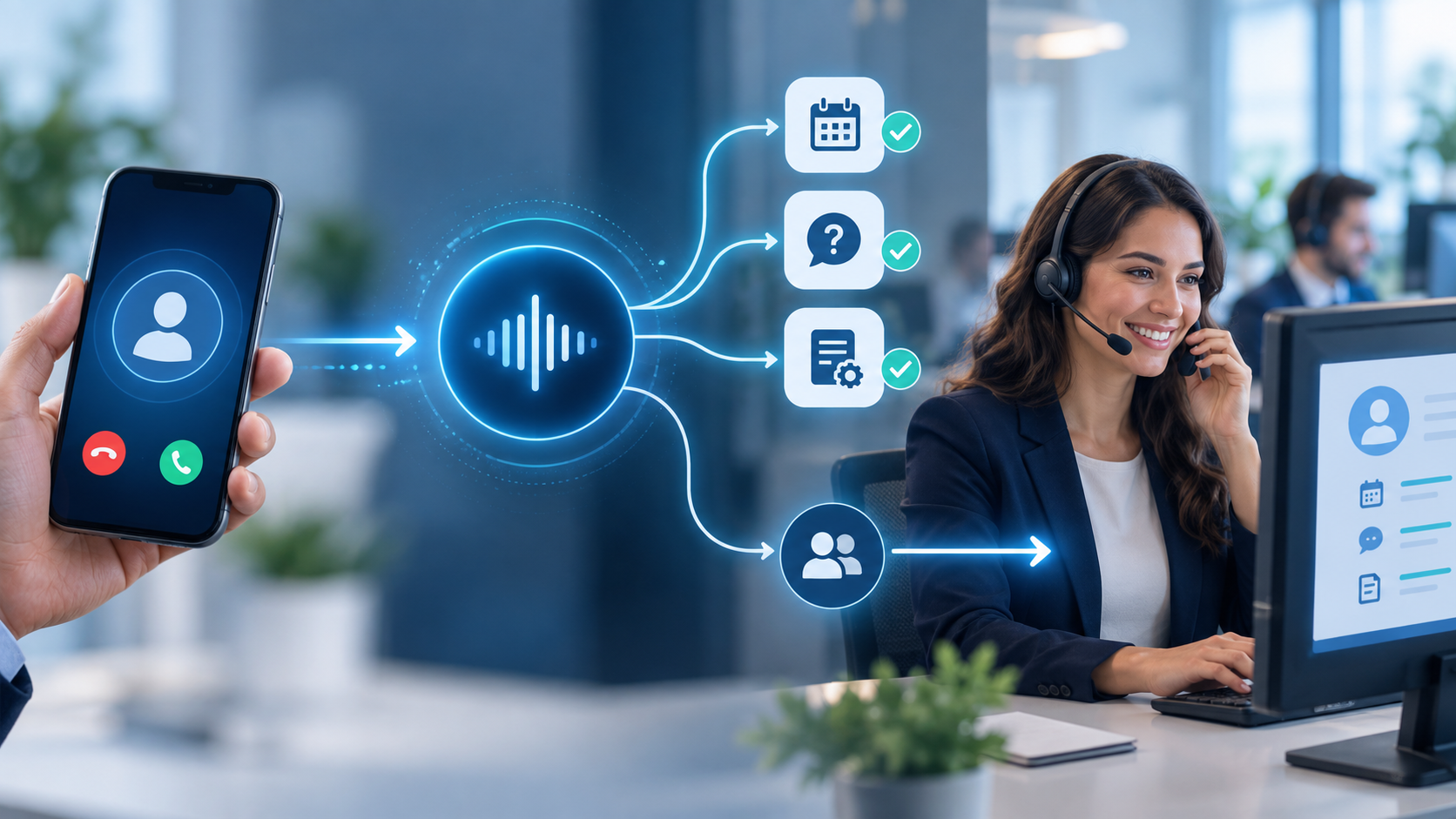
The most important AI phone assistant vs answering service question may be whether the caller’s request is resolved. A traditional agent often records a message for someone else to process. An AI assistant can be connected to approved workflows so it can book an appointment, create a ticket, check service-area rules, send an intake form, or confirm the next step before the call ends.
This is where phone automation becomes part of a larger workflow. MOATiT’s guide to AI business automations explains how connected systems can move information between calls, schedules, notifications, and operational tools.
AI Phone Assistant vs Answering Service Difference 4 Customer Experience and Human Nuance
Human agents generally have an advantage when a caller is grieving, angry, frightened, confused, or describing an unusual situation. A capable agent can interpret hesitation, adjust tone, depart from a script, and decide when compassion matters more than speed.
AI can provide clear and patient service for routine conversations, but it needs defined transfer rules. Callers should not be trapped in a loop or forced to repeat the entire conversation after escalation. A good implementation transfers both the call and the relevant context to a person.
AI Phone Assistant vs Answering Service Difference 5 Consistency and Knowledge Updates
An AI assistant follows the same approved instructions on every call. Business hours, service areas, appointment rules, pricing boundaries, and escalation requirements can be maintained centrally. That consistency is valuable, but only if someone owns the information and reviews it regularly.
A traditional answering service depends on agent training and script adherence. Strong providers have quality controls, but callers may still receive different phrasing or decisions from different agents. Businesses should ask how quickly script changes are distributed and verified.
AI Phone Assistant vs Answering Service Difference 6 Privacy Compliance and Oversight
Neither option is automatically compliant simply because a vendor uses the words secure or HIPAA-ready. The organization must understand what information is collected, where recordings and transcripts are stored, who can access them, how long they are retained, which systems receive the data, and how incidents are handled.
For healthcare organizations, the U.S. Department of Health and Human Services guidance on business associates explains when a person or organization performing services involving protected health information may be a business associate and why the appropriate written agreement matters.
Organizations evaluating AI should also consider governance, measurement, transparency, and ongoing monitoring. The NIST AI Risk Management Framework offers a voluntary structure for managing risks across the design, deployment, use, and evaluation of AI systems.
If the assistant will place outbound calls, the legal review becomes especially important. The FCC has confirmed that AI-generated voices fall within restrictions covering artificial or prerecorded voice calls under the Telephone Consumer Protection Act. Consent, identification, opt-out, and other requirements may apply depending on the use case. This article is not legal advice, so outbound campaigns should be reviewed with qualified counsel.
AI Phone Assistant vs Answering Service Difference 7 Cost Structure and Scalability
Pricing cannot be compared from the headline monthly fee alone. AI services may include setup, integrations, workflow design, usage charges, phone costs, monitoring, and ongoing optimization. Human answering services may charge by minute, call, message, agent time, service tier, holiday coverage, or after-hours usage.
The better comparison is cost per successfully resolved call. If a low-cost service takes a message that requires an employee to call back, the business still carries the labor, delay, and risk of losing the customer. If an automated system needs frequent human correction, its apparent savings may also disappear.
AI Phone Assistant vs Answering Service Difference 8 Multilingual Support
Businesses serving multilingual communities should compare more than a vendor’s list of supported languages. An AI phone assistant can be configured with approved answers and workflows in multiple languages, making coverage easier to extend without scheduling a separate agent for every shift. However, each language and use case should be tested for pronunciation, local terminology, names, addresses, and accurate escalation.
A traditional answering service may provide excellent multilingual support when qualified agents are available, but coverage can vary by language, hour, and staffing level. Ask whether callers reach a fluent agent immediately, enter a separate queue, or receive a callback. The better option is the one that delivers clear service consistently for the languages customers actually use.
AI Phone Assistant vs Answering Service Difference 9 Reporting and Continuous Improvement
An AI phone assistant can capture structured outcomes such as the reason for the call, whether an appointment was booked, which workflow was completed, when a transfer occurred, and where callers abandoned the conversation. Those patterns can help a business improve scripts, staffing, website information, and follow-up processes, provided recordings and transcripts are handled under appropriate privacy rules.
Traditional answering services may provide call logs, messages, recordings, summaries, or service-level reports, but the detail and format depend on the provider. In either model, ask for reporting that measures business outcomes rather than call counts alone. Useful metrics include first-call resolution, booking rate, transfer accuracy, abandoned calls, response time, and customer feedback.
AI Phone Assistant vs Answering Service Cost Comparison
There is no universal winner because call patterns and required tasks differ. An AI phone assistant may become more economical as call volume grows or when it replaces repetitive manual work. A live answering service may be more economical when call volume is low, conversations are complex, or the business only needs occasional overflow coverage.
Before comparing proposals, calculate monthly inbound calls, abandoned or missed calls, average call duration, after-hours demand, common reasons for calling, percentage of calls that require a person, and the value of a booked appointment or qualified lead. Then compare the full workflow rather than the answering fee alone.
When an AI Phone Assistant Is the Better Fit
The AI side of the AI phone assistant vs answering service decision is usually stronger when:
- Callers ask the same questions repeatedly.
- The business receives calls outside normal hours.
- Call volume rises suddenly or seasonally.
- Scheduling, rescheduling, intake, dispatch, or ticket creation follows clear rules.
- The phone system needs to connect with a calendar, CRM, EHR, help desk, or service platform.
- Customers benefit from immediate confirmations by text or email.
- The business can define clear situations that require human transfer.
Businesses that are also reviewing their broader communications platform can explore MOATiT’s guide to business phone systems in Idaho for additional context on call routing, mobility, unified communications, and managed support.
When a Live Answering Service Is the Better Fit
A human answering service may be the better starting point when most calls require interpretation rather than a repeatable workflow. Examples include crisis lines, bereavement conversations, delicate legal matters, executive-level relationships, unusual complaints, or situations where the caller expects extended reassurance from a person.
It may also make sense for a very small organization with low call volume and no need for software integrations. The business should still evaluate agent training, quality monitoring, escalation procedures, data handling, and whether agents are shared across many accounts.
Why a Hybrid Approach May Work Best
For many organizations, the strongest AI phone assistant vs answering service design is not all-AI or all-human. It is a layered workflow. AI answers immediately, handles approved routine requests, and gathers structured information. A trained employee or answering-service agent receives urgent, sensitive, high-value, or unusual conversations.
This approach preserves human judgment where it matters while reducing the repetitive work that creates long holds and missed calls. It also gives the business a safer implementation path: start with a narrow set of call types, review outcomes, improve the workflow, and expand only when performance is reliable.
Healthcare and dental practices need additional attention to privacy, EHR access, emergency routing, and patient expectations. MOATiT’s healthcare communications overview describes how phone, messaging, call-center functions, and clinical workflows can be coordinated.
AI Phone Assistant vs Answering Service 10 Questions to Ask
- What are the five most common reasons customers call?
- Which requests can be completed using clear rules?
- Which conversations always require a person?
- How will the system handle interruptions, accents, background noise, and unclear requests?
- What happens when the AI or agent does not know the answer?
- Can the call and its context transfer without forcing the customer to start again?
- Which systems will be integrated, and what permissions will they receive?
- How are recordings, transcripts, payment data, and sensitive information protected?
- How will accuracy, resolved calls, transfers, bookings, missed calls, and customer feedback be measured?
- Who will review performance and update information after launch?
AI Phone Assistant vs Answering Service Frequently Asked Questions
Will callers know they are speaking with AI?
Disclosure practices should be chosen deliberately and may be affected by the use case and applicable law. Clear identification can establish expectations and make it easier for callers to request a person. Businesses should avoid designing interactions that mislead callers about who or what they are speaking with.
Can an AI assistant replace a receptionist?
It can reduce routine phone work, but replacement is the wrong goal for many organizations. Front-desk staff often manage in-person visitors, exceptions, payments, documentation, coordination, and sensitive conversations. AI is most useful when it protects staff time and gives callers faster access to routine help.
Can AI handle multiple languages?
Many platforms support multiple languages, but performance varies by language, accent, audio quality, vocabulary, and workflow complexity. Each supported language should be tested with realistic callers and an appropriate human fallback.
Is an AI phone assistant secure?
Security depends on the platform, configuration, integrations, access controls, retention rules, monitoring, contracts, and operating practices. Buyers should request specific evidence rather than relying on a general security claim.
How should a business test an AI phone assistant?
Begin with a limited workflow and realistic test calls. Include common requests, interruptions, silence, background noise, ambiguous questions, angry callers, emergencies, unsupported requests, and attempted disclosures of sensitive information. Confirm that the assistant answers correctly, refuses when appropriate, transfers reliably, records the right information, and does not take unauthorized action.
AI Phone Assistant vs Answering Service The Better Choice Depends on the Call
The AI phone assistant vs answering service decision should begin with the work callers need completed, not with enthusiasm for a particular technology. AI is usually the better fit for fast, repeatable, high-volume, and system-connected requests. Human agents remain valuable when conversations demand empathy, judgment, flexibility, or relationship knowledge.
For many businesses, a hybrid model provides the best balance. Routine calls are resolved immediately, while complex or sensitive calls reach a person with the necessary context. That creates a better experience for the caller and a more sustainable workload for the team.
To see the technology in a practical context, readers can review how MOATiT’s AI phone assistant handles scheduling, intake, dispatch, and human handoff. The useful question is which combination resolves each type of call accurately, promptly, and responsibly.


