

Artificial intelligence is moving from experimentation into everyday business operations.
AI can answer customer calls, automate repetitive workflows, analyze information, support cybersecurity, assist employees, and connect systems that previously required hours of manual work.
But as AI becomes more capable, a bigger question follows:
How do we manage AI risk without treating every use of AI as equally dangerous?
Using AI to summarize meeting notes is not the same as using AI to influence a healthcare decision. An internal chatbot is not the same as an autonomous system controlling physical equipment. Yet conversations about AI safety can sometimes treat all of these systems as if they belong in the same category.
What if another industry already gives us clues about how to handle that problem?
That is the idea behind Airworthiness for Intelligence: A Tiered, Aviation-Inspired Governance Model for Artificial Intelligence, a technical paper developed by MOATiT founder and CEO Ali Khan.
The paper looks to civil aviation—not because airplanes and AI are the same, but because aviation has spent decades building systems for managing technologies with very different levels of public exposure and consequence.
Here are five AI safety lessons from aviation that could change how businesses and policymakers think about responsible AI deployment.
Table of Contents
- Why Compare AI Safety to Aviation?
- Lesson #1: Not Every Use Requires the Same Oversight
- Lesson #2: Focus on Exposure, Not Just Capability
- Lesson #3: Accountability Has Multiple Layers
- Lesson #4: Safety Doesn’t End at Deployment
- Lesson #5: Learn From Failures and Near Misses
- What Would an Aviation-Inspired AI Model Look Like?
- What These Lessons Mean for Businesses
- Where Do We Go From Here?
Why Compare AI Safety to Aviation?
Think about two pilots.
One flies a small private aircraft on the weekend.
The other flies a commercial aircraft carrying hundreds of passengers.
Both operate aircraft. Both share the same national airspace. Both need to take safety seriously.
But we don’t treat their operations as identical.
The amount of public exposure changes the requirements.
That distinction is central to Airworthiness for Intelligence. The paper argues that aviation’s governance architecture offers ideas worth examining for AI because it separates different responsibilities and scales obligations according to public exposure. 10-Framework-Executive-Brief
The comparison becomes especially interesting when we move beyond government policy and think about how businesses are actually deploying AI.
A company using an AI assistant internally faces different risks from an organization allowing AI to make or materially influence consequential decisions.
So perhaps the first question shouldn’t simply be:
“How powerful is the AI?”
A better question may be:
“What are we allowing this AI to do?”
AI Safety Lesson #1: Not Every Use Requires the Same Oversight
One of the clearest AI safety lessons from aviation is that risk exists on a spectrum.
Aviation doesn’t impose identical operating requirements on every person and organization interacting with an aircraft.
The proposed AI model follows a similar philosophy.
At one end are ordinary uses: personal AI tools, research, open-source experimentation, and routine business applications.
At the other are systems that could influence consequential decisions, control physical systems, affect critical infrastructure, or operate at population scale.
The consequences of failure are dramatically different.
Imagine two companies using the same underlying AI model.
Company A uses it to help employees brainstorm social media captions.
Company B integrates it into a process affecting decisions about people’s healthcare.
Same underlying technology.
Very different exposure.
The Executive Brief therefore proposes different tiers of oversight rather than one set of requirements for every AI application. 10-Framework-Executive-Brief
For businesses, the principle is useful even without a regulatory requirement:
Match your safeguards to what the AI is actually doing.
AI Safety Lesson #2: Focus on Exposure, Not Just Capability
AI conversations often focus on model capability.
How powerful is it?
How many parameters does it have?
How much computing power was required to train it?
Those questions can matter, but they don’t tell us everything about operational risk.
The aviation analogy offers another perspective: exposure matters.
The Executive Brief describes this as scaling obligations based on exposure rather than capability. 10-Framework-Executive-Brief
For a business, that means evaluating AI in context.
Ask questions such as:
- Who will interact with this AI?
- What information can it access?
- Can it take actions or only make recommendations?
- Can a person review important outputs?
- What happens if the AI is wrong?
- Can the mistake easily be reversed?
- How many people could be affected?
- Is the system connected to a consequential business process?
This changes the conversation from “Are we using AI?” to “How are we using AI?”
That’s a much more useful question.
A powerful AI model used for a limited internal task may present one type of risk. A less sophisticated system automatically taking consequential actions across thousands of customers could present another.
Capability alone doesn’t tell the whole story.
AI Safety Lesson #3: Accountability Has Multiple Layers
Here is where AI gets complicated.
Suppose an AI-powered business system makes a serious mistake.
Who is responsible?
The company that created the original model?
The developer who customized it?
The software platform?
The business deploying it?
The employee supervising it?
The person who connected it to another system?
In modern AI environments, the answer may involve several layers.
Aviation has dealt with a similar structural problem by separating responsibilities across people, machines, manufacturers, operators, maintenance organizations, and other participants.
The MOATiT paper proposes carrying part of that thinking into AI.
Its broader model distinguishes between the AI system, the organization deploying it, and accountable individuals, rather than assuming that responsibility belongs to only one actor.
That’s an important distinction for businesses.
An AI deployment isn’t just a model.
It may include:
Model → Data → Integration → Automation → Business Process → Human Oversight → Customer
A problem at any point can affect the final result.
That is why responsible AI Operations and intelligent automation should include more than choosing an AI tool. Organizations also need to understand how AI interacts with their data, employees, customers, permissions, workflows, and existing technology.
AI Safety Lesson #4: Safety Doesn’t End When the AI Goes Live
Imagine certifying an airplane once and then never inspecting, maintaining, or monitoring it again.
That wouldn’t make much sense.
Yet organizations can sometimes approach AI deployment in a similar way:
Build it.
Test it.
Launch it.
Move on.
One of the most practical AI safety lessons from aviation is that safety is an ongoing process.
AI systems operate in environments that change.
Models get updated.
Data changes.
Employees change workflows.
Integrations are modified.
Customer behavior evolves.
New edge cases appear.
That means organizations need to think beyond pre-launch testing.
Monitoring, logging, incident review, change management, human oversight, and rollback procedures can all become part of responsible AI operations.
This principle also appears in existing AI risk-management work. NIST’s AI Risk Management Framework is designed to help organizations manage risks throughout the design, development, deployment, use, and evaluation of AI systems. The framework is voluntary and is intended to support organizations of different sizes and sectors. NIST
For a business implementing AI solutions, that creates an important shift.
Don’t only ask:
“Does our AI work?”
Ask:
“How will we know if it stops working the way we intended?”
AI Safety Lesson #5: Learn From Failures and Near Misses
Not every safety lesson comes from a disaster.
Sometimes the most valuable warning is the incident that almost became one.
Aviation has spent decades building systems that allow professionals to report safety concerns, hazards, mistakes, and near misses.
NASA’s Aviation Safety Reporting System is one example. The program is voluntary, confidential, and non-punitive, and NASA says it has collected and analyzed more than two million aviation safety reports since 1976. Those reports are de-identified and used to identify hazards and share safety information with the aviation community. NASA
Airworthiness for Intelligence asks whether AI needs something similar.
The proposal includes a Confidential AI Safety Reporting System operating outside the regulator and an independent AI Safety Board modeled partly on aviation’s investigative structure. 10-Framework-Executive-Brief
Whether or not that exact institutional model is eventually adopted, there is an immediate lesson for businesses:
Make it easy to report when AI behaves unexpectedly.
If an employee catches an automation doing something it shouldn’t, don’t just correct the output and forget about it.
Investigate.
What happened?
Why did it happen?
Could it happen somewhere else?
Should monitoring have caught it?
Did a human-approval step fail?
Was the AI given too much access?
Does the workflow need to change?
Every incident can become information for improving the system.
What Would an Aviation-Inspired AI Safety Model Look Like?
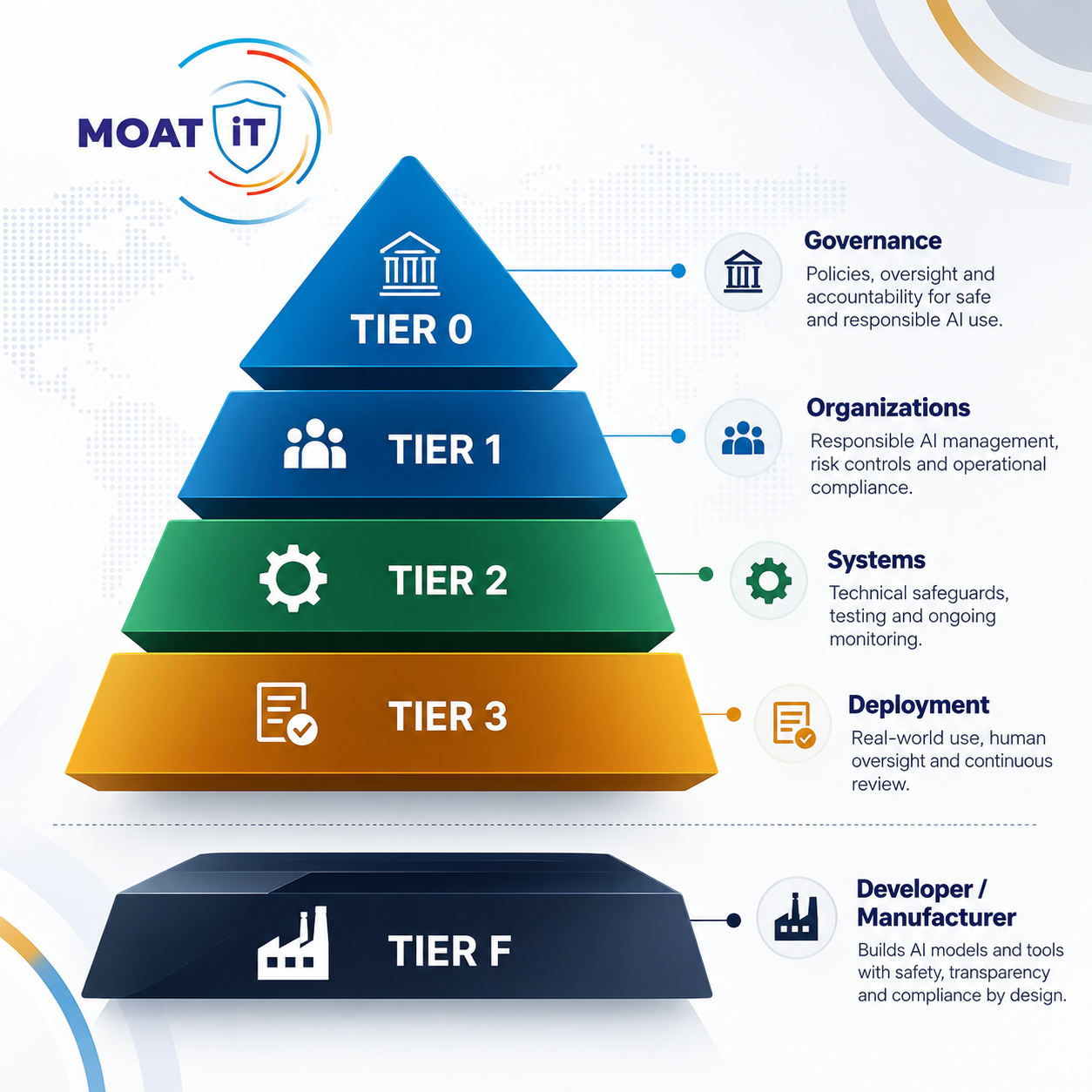
These five ideas come together in the paper’s proposed Tiered AI Assurance Framework, or TAAF.
Instead of putting all AI into one regulatory bucket, the proposal creates four deployment tiers plus a separate category for frontier developers. 10-Framework-Executive-Brief
Tier 0 — General Use
Personal, research, open-source, and ordinary business use.
Under the proposal, these uses would not require certification, registration, or individual licensing.
Tier 1 — Commercial, Low Consequence
Commercial applications where the potential consequences of failure remain relatively limited.
The proposal introduces basic organizational requirements, including registration and declaration of conformity to accepted standards.
Tier 2 — Consequential Deployment
AI that materially influences consequential decisions involving areas such as employment, credit, housing, health, benefits, or liberty, as well as certain large-scale interactions with minors.
Requirements would increase to include organizational accountability, logging, incident reporting, and independent auditing under defined conditions.
Tier 3 — Safety-Critical and High-Exposure
Systems involving physical control, critical infrastructure, or population-scale exposure.
The proposal introduces substantially stronger requirements, including system certification in context, independent verification, continuous monitoring, and rapid incident notification.
Tier F — Frontier Developers
Frontier AI developers would be treated differently from organizations simply using AI.
The proposed responsibilities include published safety frameworks, formal evaluation access, critical-incident reporting, organizational safety management, and information for downstream deployers.
The point isn’t simply to create more tiers.
It is to connect the level of oversight to how the technology is being deployed and what could happen if it fails.
Suggested Graphic #1
Another Aviation Idea: Match Evidence to the Consequence
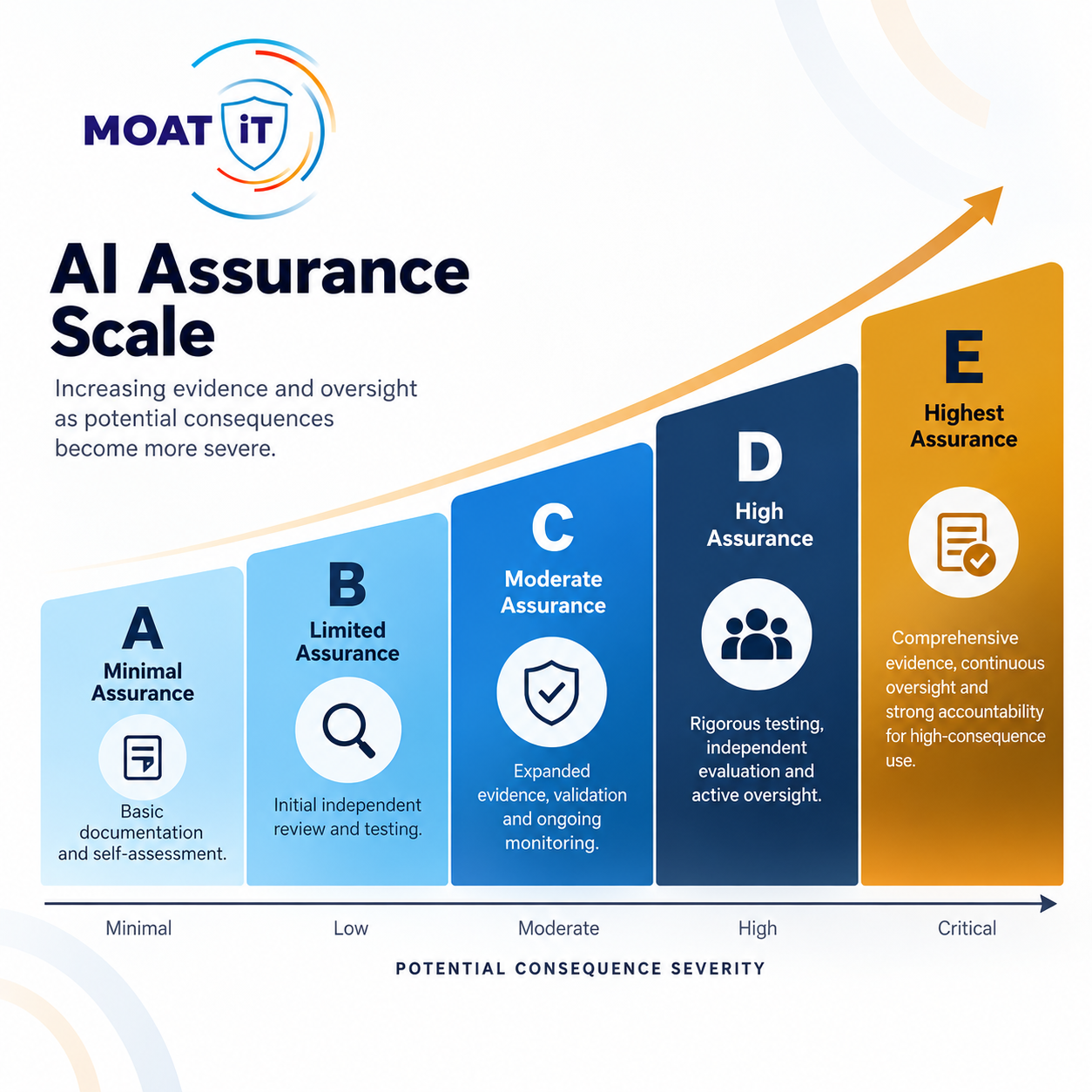
The proposal adds another layer called AI Assurance Levels, or AALs.
There are five levels—A through E—based on the potential severity of failure.
The Executive Brief describes them as translating aviation severity classifications into different evidence requirements while explicitly avoiding a direct copy of aviation’s probability targets. 10-Framework-Executive-Brief
This distinction matters.
The deployment tier asks:
Where and how is this AI being used?
The assurance level asks:
How serious could the consequences be if it fails?
As potential consequences increase, organizations could be expected to provide stronger evidence through testing, monitoring, independent evaluation, human oversight, documentation, and other safeguards.
That approach also has parallels with existing resources.
NIST’s AI Risk Management Framework is a voluntary resource intended to help organizations manage AI risks and incorporate trustworthiness considerations into AI design, development, deployment, use, and evaluation. NIST also provides an AI RMF Playbook with suggested actions around the framework’s four functions: Govern, Map, Measure, and Manage. NIST
Explore the NIST AI Risk Management Framework
What These AI Safety Lessons Mean for Businesses
You don’t need to operate a frontier AI laboratory to think seriously about AI safety.
For most businesses, responsible deployment can start with something much simpler:
Know where your AI is.
Create an inventory of the AI systems and automations your organization uses.
Then determine what each system can access, who is responsible for it, whether it can take actions independently, and what could happen if it makes a mistake.
A marketing assistant doesn’t necessarily require the same controls as an AI system handling sensitive customer information or influencing an important operational decision.
The safeguards should reflect the use.
Businesses can also define when human approval is required, keep appropriate logs, establish escalation procedures, test significant changes before deployment, and maintain a way to disable an automation if it begins behaving unexpectedly.
This is especially important as AI becomes embedded deeper into normal business technology.
At MOATiT, our work with AI solutions for business focuses on practical applications such as automation, communications, cybersecurity, and operational tools. As those capabilities expand, governance increasingly becomes part of good technology management—not a separate conversation that happens afterward.
AI Safety Doesn’t Have to Mean Slowing Down AI
The aviation comparison reveals something important.
Safety and innovation don’t automatically have to be opposing goals.
The question is how to create safeguards that make sense for the actual level of exposure.
Airworthiness for Intelligence deliberately does not propose licensing individual AI users, pre-approving general-purpose AI for ordinary use, or using computing power as the primary trigger for oversight. 10-Framework-Executive-Brief
Instead, the proposal asks whether requirements should become stronger as AI moves from ordinary use into consequential, high-exposure, or safety-critical environments.
That distinction may become increasingly important as AI becomes part of everyday business operations.
Where Do We Go From Here?
AI is still changing quickly.
The models businesses use five years from now may look very different from the ones we use today.
That makes the underlying principles behind these AI safety lessons from aviation particularly interesting.
Don’t treat every deployment the same.
Look at exposure, not just capability.
Define accountability.
Keep monitoring after deployment.
And learn from failures before they become bigger failures.
Those ideas don’t answer every question about AI governance.
But they give businesses, researchers, technology providers, and policymakers another way to think about the problem.
And perhaps the most useful question isn’t:
“How much AI regulation do we need?”
It may be:
“What level of assurance makes sense for what this AI is actually being trusted to do?”
Explore Airworthiness for Intelligence
These five lessons represent only part of the framework.
MOATiT’s Airworthiness for Intelligence: A Tiered, Aviation-Inspired Governance Model for Artificial Intelligence explores the proposed Tiered AI Assurance Framework, AI Assurance Levels, institutional responsibilities, incident reporting, independent verification, and other elements in greater depth.
→ Read the full Airworthiness for Intelligence resource
For organizations interested in the practical side of AI deployment, explore MOATiT’s AI Operations & Intelligent Automation and AI Solutions for Business.


