
Quick answer: Missed business calls cost you the sales your team never gets a chance to close. To estimate the cost, multiply your unique missed callers by the share that are qualified leads, the share you never recover, your conversion rate, and your average first sale. Then close the gap with better routing, clear callback ownership, live answering, or an AI phone assistant.
Your phone rings while your technician is under a sink in Pocatello. Or it’s 6:15 p.m. in Idaho Falls and the office lights are off. The caller hangs up, and you never learn whether they were a new customer, a supplier, or a spam bot.
That uncertainty is the real problem with missed business calls. Not every unanswered call is a lost sale, but some are, and most small businesses have no idea how many.
In this guide, we’ll show you how to put a dollar figure on missed business calls, how common they are by industry, and five proven ways to recover more callers before they dial your competitor.
[Insert Rank Math Table of Contents block here]
How Do You Calculate the Cost of Missed Business Calls?
You calculate it by counting only the qualified callers you never recovered, then applying your normal conversion rate and first-sale value. Leave out spam, suppliers, existing-customer requests, repeat attempts from the same number, and callers outside your service area.
Use this planning formula:
Revenue at risk = Unique missed callers × Qualified lead share × Unrecovered share × Conversion rate × Average first-sale revenue
The unrecovered share is the percentage of qualified missed callers your follow-up never reached. Your conversion rate should come from similar leads your team handled well, not from every call you receive.
A Hypothetical Monthly Example
| Input | Example |
|---|---|
| Unique missed callers | 100 |
| Qualified new-lead share | 50% |
| Qualified leads not recovered by follow-up | 60% |
| Conversion rate when handled well | 40% |
| Average first-sale revenue | $500 |
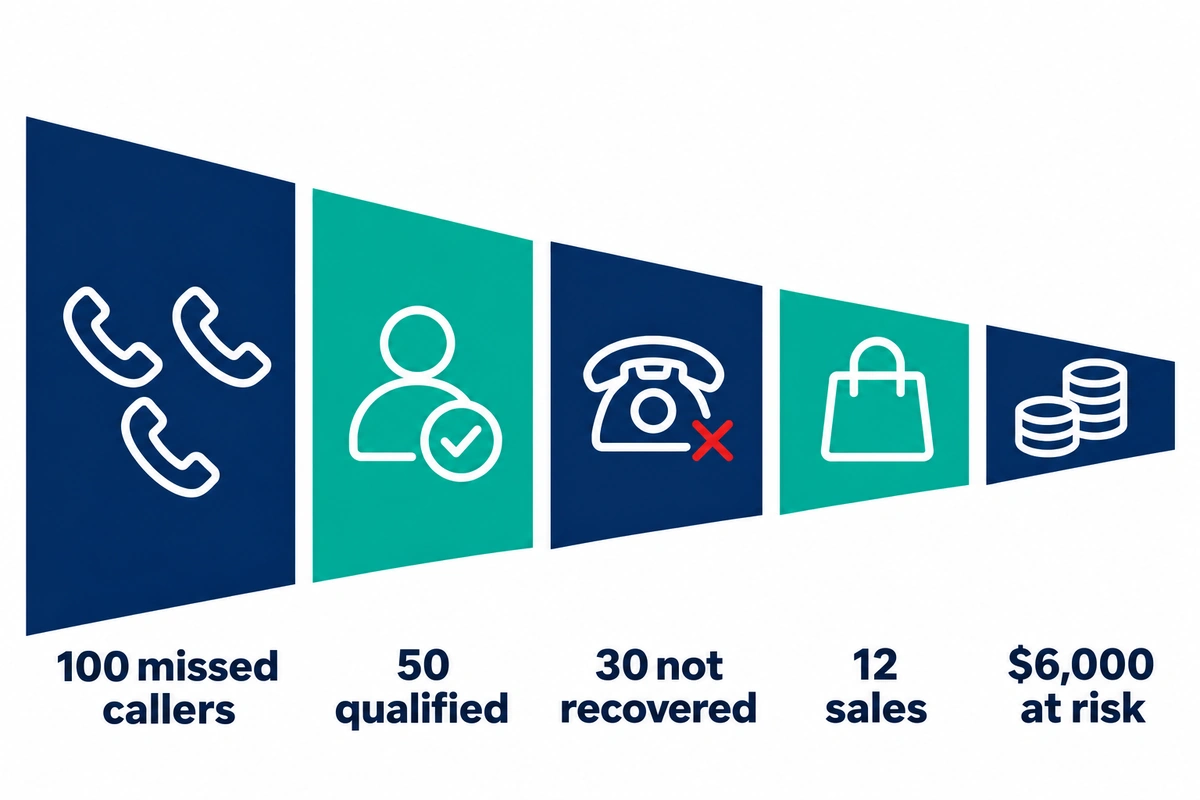
100 × 50% × 60% × 40% × $500 = $6,000 in monthly revenue at risk.
Here’s how that works out: 100 missed callers include about 50 real prospects. Callbacks recover 20, leaving 30 unresolved, and at a 40% close rate that’s 12 sales worth $500 each.
This is a scenario, not proof that a business lost $6,000. It’s also revenue, not profit, so use contribution profit when you compare it against the cost of a solution.
No Data Yet? Start With Published Benchmarks
If you don’t track calls today, published benchmarks give you a reasonable starting range. In its June 2025 call conversion benchmark release, Invoca reported that 35% of calls from digital marketing were qualified leads and 37% of phone leads converted during the call.
Treat those as placeholders until your own 30-day audit replaces them. Your industry, market, and team will move the numbers.
How Common Are Missed Business Calls?
Missed business calls are common, and the rate varies widely by industry. CallRail’s January 2025 small business benchmark reported these missed-call rates:
| Industry | Reported missed-call rate |
|---|---|
| Healthcare | 32% |
| Legal | 28% |
| Home services | 14% |
| Real estate | 9% |
Source: CallRail’s 2025 benchmark release, based on 1.1 million de-identified conversations across seven industries. The full report, From Conversations to Conversions, breaks results down by industry.
Invoca’s analysis of more than 60 million calls found that 61% of callers spoke directly with a person, with answer rates ranging from 54% to 69% by industry. Invoca also noted that some calls without a person were still resolved by automation, so the rest should not be counted as lost customers.
For Idaho medical and dental offices, law firms, and home service companies, those numbers are worth a hard look. A front desk that’s checking in a patient or a crew that’s on a job site can’t always pick up.
Why Fix Missed Business Calls Before Buying More Leads?
Because more advertising just sends more callers into the same bottleneck. If calls already go unanswered, a bigger ad budget can raise your cost per customer instead of your revenue.
CallRail found that Google Ads (37%), Google Business Profile (23%), and organic search (22%) drove the most calls and texts for small businesses. In other words, the calls you miss are often the ones you already paid or worked hardest to earn.
Connect each new inquiry to its source where you can, then follow it through to booking and a completed sale. That shows you whether you have a coverage problem, a follow-up problem, or a sales-process problem.
5 Proven Ways to Stop Losing Revenue to Missed Business Calls
The right fix depends on when calls go unanswered, what callers need, and what your team can realistically manage. Most businesses combine two or three of these.
1. Run a 30-Day Missed-Call Audit
You can’t fix what you don’t measure. For 30 days, record:
- Total inbound calls and unique callers, with repeat attempts flagged
- Unanswered calls during business hours and after hours
- Qualified new inquiries, kept separate from existing customers and vendors
- Callback attempts, successful contact, and time to follow up
- Marketing source, appointments booked, completed sales, and first-sale revenue
- Calls resolved by automation and inquiries that stayed unresolved, with the reason
Seasonal or low-volume businesses may need 60 to 90 days. Give late-month leads time to move through your normal sales cycle before you judge results.
2. Fix Routing Inside Your Phone System
Many missed business calls happen during short daytime peaks, not after hours. Ring groups, overflow rules, and call forwarding can send a call to the next available person instead of voicemail.
A modern cloud VoIP phone system lets desk phones, computers, and mobile apps ring on the same number, so a technician in the field can still answer. MOATiT sets this up for teams in Pocatello, Boise, Twin Falls, and Salt Lake City.
3. Give Every Missed Call a Callback Owner
A voicemail nobody owns is a lead nobody calls back. Assign one person or role to clear missed calls, and set a target, such as returning every new-customer call within one business hour.
Where your phone system supports it, an automatic text to missed callers buys you time and shows you noticed. Track time-to-callback in your audit so you can see whether it improves.
4. Use a Live Answering Service for Complex Intake
If callers often need human judgment, a live answering service can take detailed messages, follow a script, and transfer urgent calls. Test script accuracy, access to your booking calendar, and how the service handles several calls at once.
Live services work best when your intake questions change often or require empathy, like a legal consultation or a sensitive medical question.
5. Add an AI Phone Assistant for After-Hours and Overflow Calls
An AI phone assistant answers spoken requests using your approved business information and workflows. It’s a strong fit for repeatable questions, appointment booking, overflow during busy hours, and after-hours answering.
MOATiT’s AI phone assistants are built to answer calls, book appointments, send confirmations, and hand callers to a person when needed. Before you choose any AI call answering tool, test:
- Does it answer accurately about your services, hours, and service area?
- Can it book directly into your real calendar without double-booking?
- What happens when a caller interrupts, changes the request, or asks something unexpected?
- Can it transfer to a person or create a clear follow-up task?
- Can your team review transcripts and correct mistakes?
- What is the full monthly cost, including setup, usage, and integrations?
For healthcare and other sensitive workflows, confirm HIPAA safeguards and a signed business associate agreement. Also review call-recording rules: Idaho is a one-party consent state under Idaho Code § 18-6702, but callers in other states may be covered by stricter laws.
Which Option Fits Your Business?
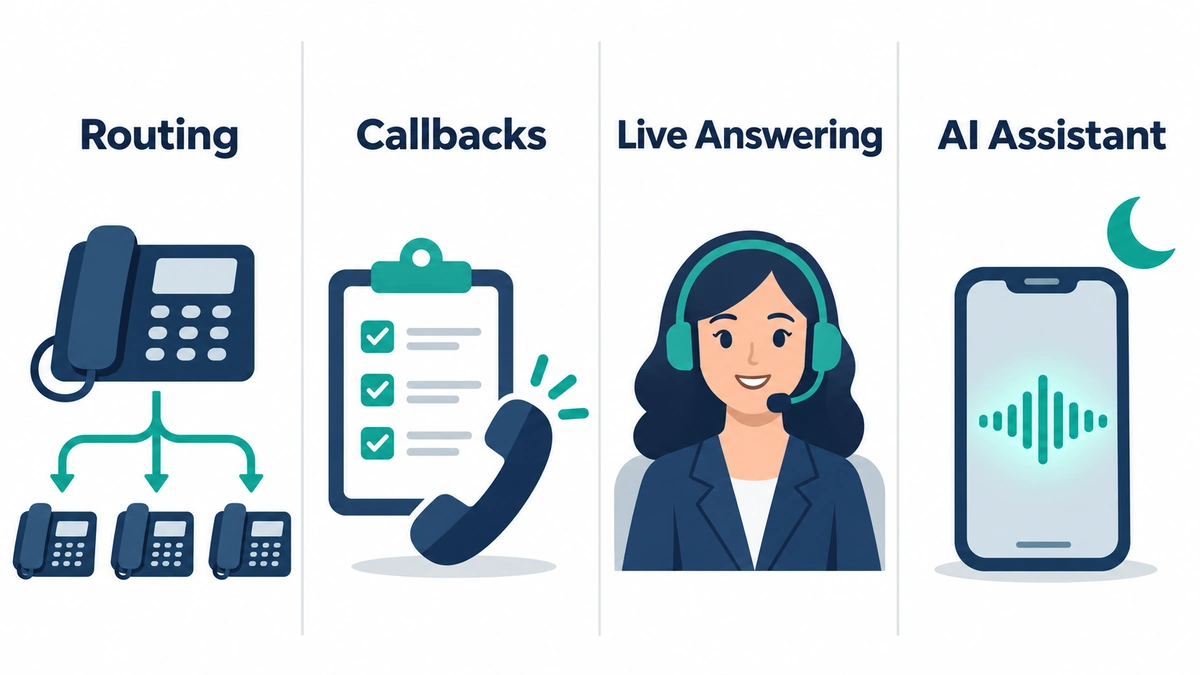
| Option | Best when | What to test |
|---|---|---|
| Better internal routing | Calls are missed during short daytime peaks | Ring groups, overflow, mobile app answering |
| Callback ownership | Voicemails pile up without follow-up | Owner, time-to-callback, text-back |
| Live answering service | Callers need frequent human judgment | Script accuracy, booking access, transfers |
| AI phone assistant | Repeatable questions, booking, overflow, after hours | Accuracy, calendar sync, handoff, review tools |
How Do You Know If Call Answering Pays for Itself?
Divide the full monthly cost of the solution by the contribution profit from one additional sale. The result is how many extra sales you need each month to break even.
Monthly answering cost ÷ Contribution profit per additional sale = Sales needed to break even
For example, a $300-per-month service needs three extra completed sales if each one contributes $100 after delivery costs. Count only sales you would not have recovered anyway, and make sure your team can handle the extra work.
A higher answer rate is an operational win. Completed sales and contribution profit tell you whether it’s a financial one.
Frequently Asked Questions About Missed Business Calls
How much do missed business calls cost a small business?
It depends on your call volume, close rate, and average sale. Multiply unique missed callers × qualified share × unrecovered share × conversion rate × average first sale. In our hypothetical example, 100 missed callers a month put about $6,000 in revenue at risk.
What percentage of business calls go unanswered?
CallRail’s 2025 benchmark reported missed-call rates from 9% in real estate to 32% in healthcare. Invoca found 61% of callers spoke with a person, though some of the rest were resolved by automation.
Is after-hours answering the same as AI call answering?
No. After-hours answering describes when calls are covered. That coverage can come from your own team, a live answering service, or an AI phone assistant.
Can an AI phone assistant replace my receptionist?
Usually it works best alongside your team, not instead of it. AI handles repeatable questions, booking, and overflow, then hands complex or sensitive calls to a person.
Is it legal to record business calls in Idaho?
Idaho is generally a one-party consent state under Idaho Code § 18-6702. Callers from other states may be covered by stricter rules, so check with your attorney before you turn on recording.
Stop Guessing What Missed Business Calls Cost You
MOATiT is a Pocatello-based technology company helping businesses across Idaho, Utah, Wyoming, and Montana answer more calls with business phone systems and AI phone assistants. Bring your call log and current workflow, and we’ll help you find where callers are slipping through.
Want to hear it for yourself? Call (208) 900-6628 and Castle, MOATiT’s AI phone assistant, will pick up. Try booking an appointment or asking about pricing, exactly as your customers would.
Related reading: How AI and smart automation fit your business · 7 Proven Benefits of Small Business IT Support in Idaho · Best VoIP Phone Systems in Pocatello


