
Missed business calls are easy to overlook, because nobody complains about a call they never got through on.
Your phone rings while your team is helping customers. A quote request goes to voicemail at lunch. Another caller hangs up after closing. Before you pay for more leads, find out what happened to the ones who already called.
Quick answer: Review 30 days of call logs. Divide missed inbound call attempts by total inbound call attempts and multiply by 100 to find your missed-call rate. To estimate revenue at risk, multiply the number of qualified sales inquiries you missed and never recovered by your close rate for similar leads and your average first-sale revenue.
Table of Contents
Missed Business Calls: How Many Are You Missing, and What Do They Cost?
Why missed business calls matter
Step 2: Sort missed business calls by type
Step 3: Calculate what missed business calls cost
Step 4: Find when and why calls go unanswered
Step 5: Fix the gap and measure the results
What should after-hours answering handle?
Can AI call answering reduce missed business calls?
What is a good missed-call rate?
Should I count hang-ups with no voicemail?
How quickly should I return a missed call?
Do I need a new phone system to stop missing calls?
Hear an AI phone assistant answer a real call
Why missed business calls matter
Some callers don’t wait for a callback. In a survey of 1,000 U.S. consumers, published in September 2025 by call-tracking company CallRail:
- 78% said they had abandoned a business after an unanswered call.
- 21% said they immediately call another business when nobody picks up.
- Only 42% said they leave a voicemail.
CallRail sells call-tracking and AI voice tools, so treat these numbers as a warning sign rather than a forecast for your business. Your own call logs will tell you much more. The five steps below show you how to read them.
Step 1: Pull your call logs
To measure missed business calls, export 30 days of inbound calls from your phone system. If your call volume is low or seasonal, use a longer period that reflects normal demand.
Start with calls that went to voicemail or ended before anyone picked up. Check one setting first: some systems mark a call as “answered” when it reaches an automated greeting. Confirm whether the caller actually reached a person or completed a next step.
Then track two numbers:
- Missed-call rate: missed call attempts ÷ all inbound call attempts.
- Unrecovered qualified inquiries: distinct sales opportunities that fit your business and never reconnected through a callback, another call, a form, or a booking.
Count each call attempt in your missed-call rate. Count repeat calls about the same job once when estimating revenue at risk.
Step 2: Sort missed business calls by type
Not every missed call is lost revenue. Sort each one before you put a dollar figure on it.
| What you find | How to log it |
|---|---|
| A homeowner leaves a message asking for a quote on work you do | Qualified inquiry. Check whether your team followed up or the caller came back another way. |
| The same homeowner calls again and speaks to your team | Recovered inquiry. Track the booking or sale as a separate outcome. |
| An existing customer calls about an invoice | Customer service. Track it separately from new sales inquiries. |
| A caller hangs up without a message, and you can’t tell why | Unknown. Report it separately and leave it out of the revenue estimate. |
| Spam, a wrong number, or a request outside your service area | Exclude it from the revenue estimate. |
Give recent calls your normal follow-up window before you count them as unrecovered. A return call that also goes to voicemail is only an attempt. Mark an inquiry as recovered once you make contact or confirm the caller took the next step another way.
Step 3: Calculate what missed business calls cost
Use this formula:
Estimated revenue at risk = unrecovered qualified inquiries × close rate for similar inquiries × average first-sale revenue
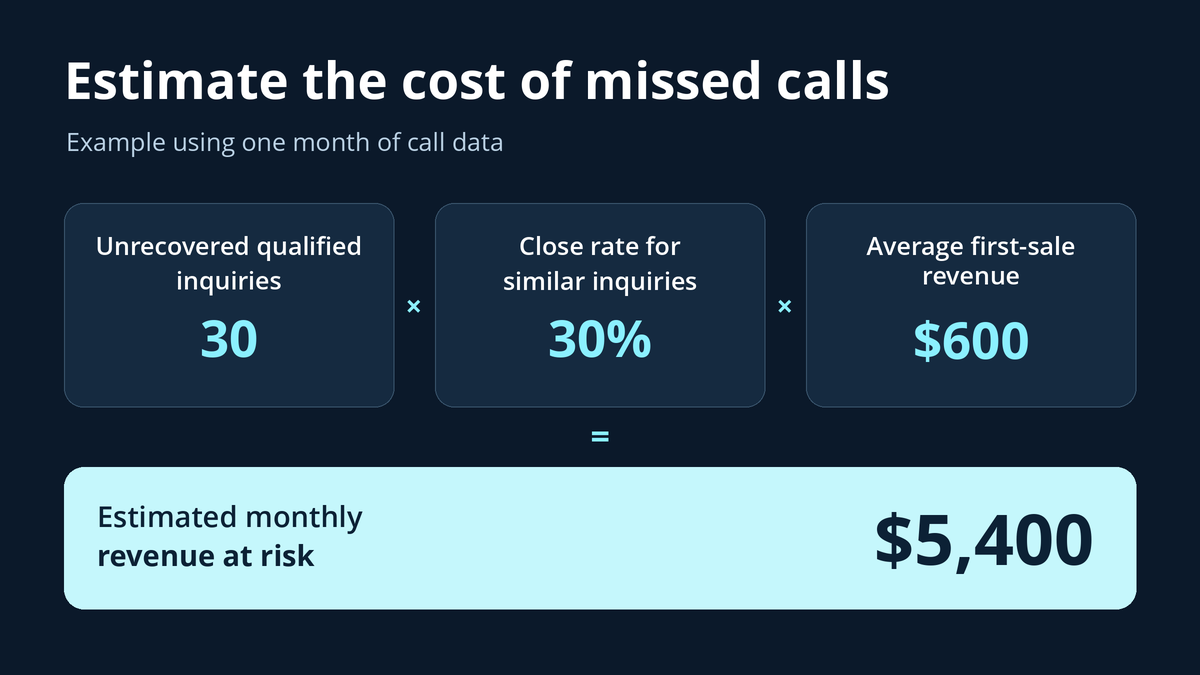
Here’s an example for a local service business that reviews one month of missed business calls:
| Metric | Example |
|---|---|
| Inbound call attempts | 400 |
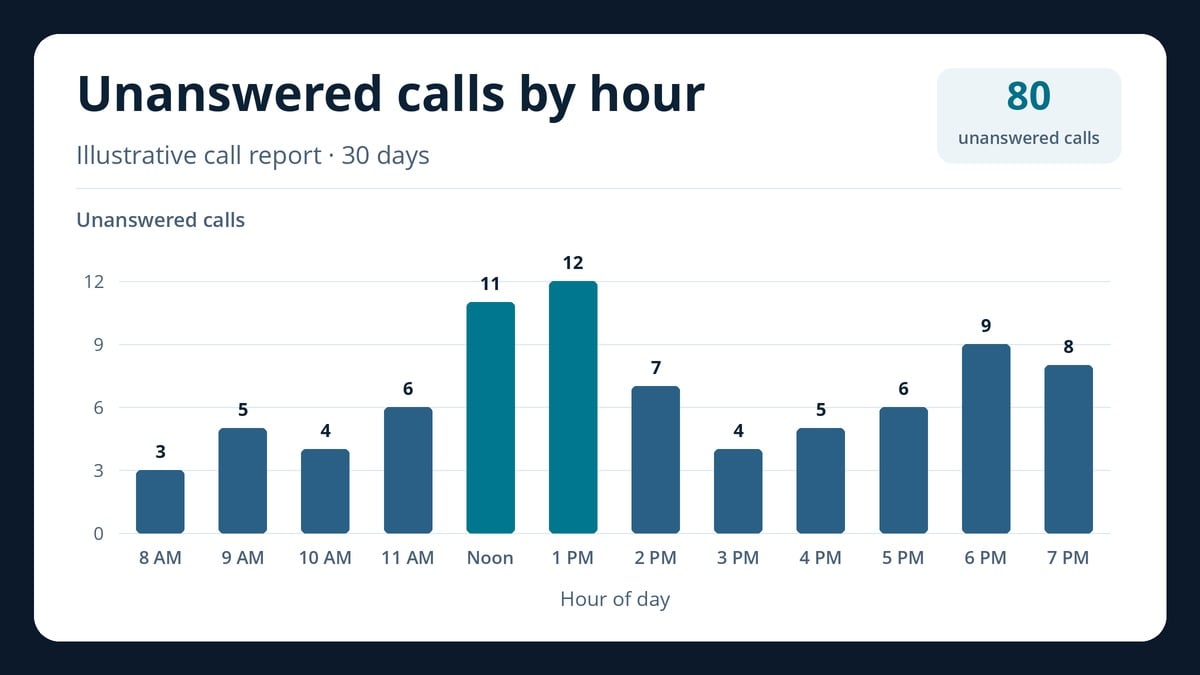
| Missed call attempts | 80 |
| Missed-call rate | 20% |
| Distinct qualified sales inquiries among missed calls | 40 |
| Qualified inquiries recovered | 10 |
| Qualified inquiries still unrecovered | 30 |
| Close rate for similar inbound inquiries | 30% |
| Average first-sale revenue | $600 |
| Estimated monthly revenue at risk | $5,400 |
These numbers are hypothetical. The $5,400 assumes the prospects you missed would have closed at the same rate as similar leads your team did reach. If your close rate varies by service or lead source, use the rate that best matches the calls you missed.
Want to try this with your own numbers? Use MOATiT’s missed-call calculator for a quick estimate. It asks for your missed calls in a normal week, while the example above uses a month. For a more precise figure, first remove repeat calls and inquiries your team recovered.
Is fixing it worth the cost?
Revenue isn’t profit. To decide whether extra coverage pays for itself, use what you keep from a sale after direct delivery costs.
If you keep $250 per sale and coverage costs $500 a month, you need two extra sales a month to break even. Add setup fees, usage charges, and any extra staff time to get the full cost.
Step 4: Find when and why calls go unanswered
Group your missed business calls by day and hour, then look at where qualified inquiries get stuck. An HVAC company fielding repair requests after closing has a different problem from a front desk that misses calls at lunch.
| What your call logs show | What to try |
|---|---|
| Calls go unanswered during lunch or short daytime rushes | Set up overflow routing to a backup person or team. |
| Qualified inquiries arrive after closing or on weekends | Compare a live answering service with AI call answering for those hours. |
| Callers ask routine questions or want to schedule | Test whether an AI phone assistant can use approved answers and your booking process. |
| Calls involve exceptions or need staff judgment | Set up a clear handoff to a team member or a trained answering service. |
| Messages are captured, but callbacks stall | Assign each callback to one person and track whether the caller was reached. |
If routing is the problem, start with the settings in your business phone system. Check what happens when the main line is busy, when nobody picks up, and after hours.
Step 5: Fix the gap and measure the results
Pick the fix for your missed business calls that matches the pattern you found in Step 4. Then make sure every caller gets a clear next step, whoever or whatever answers.
At a minimum, it should:
- Take a message and tell the caller when to expect a callback.
- Answer common questions, such as your hours or service area.
- Book an appointment, but only when the system can reserve a real time slot. A request for “Tuesday morning” stays pending until someone confirms it.
Can AI call answering reduce missed business calls?
Yes, when it’s set up well. An AI phone assistant can cover overflow and after-hours calls, capture caller details, and route requests based on the rules you set.
Before you choose one, test the hard cases:
- A caller asks for a person.
- A caller gives incomplete information.
- A transfer fails.
Then check where each message goes and who owns the follow-up.
Measure against your baseline
After adding coverage, compare a similar period with the baseline from Step 3. Look at qualified inquiries recovered, bookings made, and sales closed, not just the answer rate. Those outcomes tell you whether the change is worth keeping.
Missed business calls FAQ
What is a good missed-call rate?
There’s no universal benchmark, because it depends on your industry, staffing, and call volume. Your best benchmark is your own baseline from Step 1. Then watch whether it drops after you make a change.
Should I count hang-ups with no voicemail?
Count them in your missed-call rate, but leave them out of the revenue estimate unless you can identify the caller and confirm they were a sales inquiry.
How quickly should I return a missed call?
In CallRail’s survey, about one in five consumers said they call another business right away when nobody answers. Return missed calls as soon as your team can. If callers regularly reach you after closing, tell them when to expect a callback.
Do I need a new phone system to stop missing calls?
Not always. Many missed business calls can be fixed with better overflow, after-hours routing, and a clear callback owner. If your current system can’t do those things, MOATiT’s Idaho Falls and Pocatello business phone teams can help you compare options.
Hear an AI phone assistant answer a real call
Missed business calls don’t have to go to voicemail. Call MOATiT at 208-900-6628 to hear our AI assistant, Castle, answer live. Or request a demo for your business, and we’ll show you how it would handle your calls.


